
Forget AI Agents: Why MCP and RAG Will Shorten Your B2B Sales Cycles
Shorter sales cycles, higher win rates
If you’re selling AI-driven building optimisation to commercial property owners, you already know the problem. Your technology works. Your clients see real results in energy savings and lower maintenance costs, with measurable ROI.
But your sales cycles are running six to twelve months. Deals stall at the same question every time:
“How do we connect your system to our existing building infrastructure without a six-month project just to get started?”
The answer isn’t building smarter autonomous AI agents. The key is getting your data layer and integration layer right, before the first customer call.
The B2B Sales Problem in Technically Complex Verticals
B2B sales in PropTech, energy and IoT are complex by nature. Procurement involves multiple stakeholders. Technical due diligence is thorough. And the integration question looms over every conversation.
Your prospect might be genuinely interested, but they can’t commit until they know what connecting to their building management system or existing data infrastructure will actually cost, and how long it will take.
There is great appeal to using AI agents in B2B PropTech. But the sales cycle problem runs deeper than any agent can fix on its own, with long evaluation periods and win rates that still disappoint despite strong product-market fit.
Why Most AI Implementations Fail Before the First Demo
Before we get to the solution, let’s consider why so many AI initiatives in these verticals fail.
According to research by the RAND Corporation, more than 80% of AI projects fail to reach meaningful production deployment, roughly twice the failure rate of traditional IT projects.
The root cause is almost never the model. It’s the data.
Energy and IoT AI initiatives fail because the data feeding them isn’t trusted or usable. The real blockers are:
- Sensors without timestamps
- Siloed building data that nobody has ever unified
- Unstructured formats never designed for machine learning
Even if you deploy the most sophisticated model available – it will still produce outputs nobody trusts if the inputs are unreliable.
The same logic applies when you put AI into your sales process. Rush to deploy autonomous AI sales agents and you hit the same wall:
- No reliable context about your prospect
- No access to your project history
- No way to generate a credible ROI estimate
- Generic outputs that a technical buyer sees through immediately
You lose the deal before you’ve had a real conversation. But there is an alternative.
The Data Layer – RAG on Historical Project Data
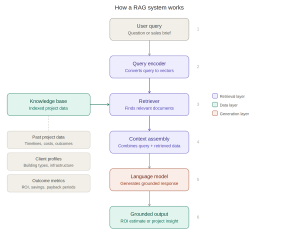
Example RAG system flowchart
Retrieval-Augmented Generation (RAG) pulls relevant information from a data source you control and uses it to produce accurate, specific outputs.
For your B2B sales process, the most valuable source of data is your own project history.
Every completed engagement holds answers to the questions your prospects are already asking. That data includes:
- Integration costs by project type
- ROI timelines and payback periods
- Common complications and how they were resolved
- Real-world energy savings in year one and beyond
That institutional knowledge almost never makes it into the sales process in a structured, queryable form. RAG development changes that.
RAG indexes your historical project data (delivery timelines, integration costs, outcome metrics, client profiles), helping your team generate answers specific to a given prospect’s needs in real time. Instead of a salesperson trying to recall a vaguely similar past project, you produce a data-backed response to the questions your prospect is already asking.
But this only works if your project data is actually structured and accessible.
If it lives in spreadsheets, email threads and the heads of senior engineers, that’s a data engineering problem, and it should be the first thing you solve before building anything else. The work involves standardising how your delivery teams document projects, then designing pipelines to ingest those fragmented sources, clean the noise and centralise the output into a single, reliable feed your RAG system can actually use.
It’s not very glamorous, but it’s the foundation everything else depends on. We cover the mechanics of this in detail in our article on building AI-ready energy data pipelines, work we help clients scope and build directly.
The Integration Layer: Where MCP Changes the Equation
Getting your data layer right solves half the problem. The other half is connecting your AI to your client’s existing systems. And that integration is where deals go to die.
The Legacy Integration Problem in PropTech and Energy
Your clients are running smart building technology like building management systems, SCADA platforms and IoT infrastructure that is anywhere from 5 to 25 years old. These systems were built in isolation and were never designed to share data with modern software platforms.
Connecting your AI product to this landscape has traditionally meant a bespoke integration project for every single client, which is expensive and time-consuming, making it a hard sell.
The challenge of legacy application modernisation is familiar to anyone building in these verticals. For a vendor in your position, that integration cost gets factored into every pricing conversation and every timeline estimate, killing sales momentum.
Why MCP Has Become the Industry Standard
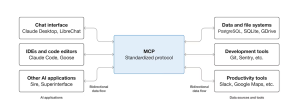
Diagram of MCP data flow – https://modelcontextprotocol.io/
Model Context Protocol (MCP) is an open standard, originally developed by Anthropic, that defines how AI systems connect to external data sources and tools.
Rather than building a custom integration between your AI and each client’s systems, MCP gives you one standard that any compliant system can connect to.
What makes it relevant right now is the pace of adoption. OpenAI, Google and Microsoft all joined the MCP ecosystem in 2025, and it’s rapidly becoming the default integration standard across enterprise AI.
For your IoT and cloud solutions, that means a concrete reduction in integration complexity. Published MCP adoption data shows average integration time falling from 18 hours of custom development to 4.2 hours, with 56% of organisations reporting significantly reduced costs.
In a sales conversation, that changes your answer from, “We’ll need to scope integration separately,” to something far more powerful:
“Here’s what a standard integration looks like for a project like yours. Here’s what it costs. Here’s how long it takes.”
Your technical lead stops thinking “great, more scoping I don’t have time for” and starts thinking “I’m learning something I can actually take back to the rest of the leadership team.”
What a Winning Pre-Sales Workflow Looks Like
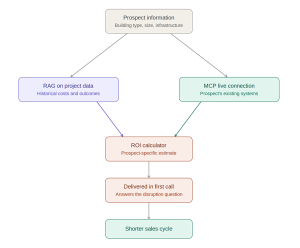
Example of an integrated RAG + MCP pre-sales workflow in PropTech
Your ideal pre-sales workflow starts before the first meeting.
Using RAG on your historical project data, you build a system that, given basic prospect information like building type, size and existing infrastructure, retrieves comparable past projects and generates a preliminary analysis. You walk into the first meeting already knowing things your prospect expects you to take weeks to discover. This puts you leagues ahead of the competition.
The goal of that first call is to deliver a quantified ROI estimate. Not a range, not a promise, but a number grounded in your own project history.
RAG provides the historical context. MCP provides the live connection, pulling real data from your prospect’s existing systems to ground the estimate in their actual baseline.
The result is an ROI calculator you can run live during the meeting, answering the question every technical buyer is asking internally: is this worth turning our entire infrastructure upside down?
The numbers support the approach. Research by Ebsta across 4.2 million B2B opportunities found that teams aligned with data-driven sales processes achieved 87% higher win rates and 21% shorter sales cycles. For verticals where integration uncertainty and ROI ambiguity are the primary blockers, a well-implemented RAG and MCP workflow can push toward the upper end of both.
What the Winners Are Doing Differently
The most successful teams in these verticals share three habits.
-
They sell outcomes, not platforms.
Rather than presenting a feature list or a per-seat licensing model, they structure commercial agreements around performance: guaranteed energy savings, measurable maintenance cost reductions, verifiable ESG metrics. The conversation shifts from “What does your software do?” to “What result will we see, and what happens if we don’t?”
-
They treat integration as a sales asset, not a post-sale problem.
By investing in MCP-based integration infrastructure early, they can describe integration in concrete terms before the prospect asks. As we cover in our work on secure software development, early architectural decisions determine the risk profile of everything that follows. Integration strategy is no different.
-
They use more data in the sales process than their competitors.
By the time a competitor is asking discovery questions, these teams are already presenting findings. That’s what wins deals in technically complex verticals.
Where to Start with RAG + MCP Implementation
Maybe you’re thinking, “This sounds right, but where do we actually start?” The first thing to assess is where the gap is, almost certainly in one of two places:
- Your historical project data isn’t structured in a way that supports RAG
- Your integration approach is still client-by-client and bespoke
Both are solvable, but only after a clear-eyed assessment of what you actually have. Don’t invest in AI tooling before your data layer can support it. That’s the failure mode you’re trying to avoid.
The right starting point is a structured discovery sprint: mapping what project data exists, in what form, and what integration patterns are already in place or could be standardised. That defines the realistic scope of your RAG development and MCP integration strategy before you commit to a full build.
Start with the Data, Not the Technology
DO OK is a senior software engineering studio specialising in PropTech, IoT and AI product development. We build the software layer that connects your hardware to business value. Our discovery workshops are designed exactly for this kind of scoping, mapping your current-state data and integration architecture and identifying what’s needed to support AI-driven pre-sales workflows, then defining a build sequence that delivers early value without over-committing resources.
The companies compressing their sales cycles right now didn’t start by deploying autonomous AI agents. They started by getting honest about their data and their integration approach. That’s where we’d suggest you start too.
Want to explore what a RAG and MCP pre-sales workflow could look like for your product? Get in touch to start the conversation.