
How Product Discovery Workshops Help Reduce Risk and Build Right
Ask a few CTOs and product teams, and they will tell you that “discovery” just means a few loose conceptual conversations before the real work begins. But a focused discovery phase actually does much more. It reduces uncertainty, aligning stakeholders and exposing technical constraints that shape the entire build. For complex systems, it might be the only moment where incorrect assumptions can be corrected before they turn into costly architecture decisions.
Structured product discovery workshops shorten delivery timelines, reducing rework and preventing months of unnecessary development effort.
Why Does Product Discovery Exist?
Even the best ideas sometimes fail in execution. Not because of bad code, but because no one took the time to test whether the product solved the right problem in the right way. The purpose of product discovery is to turn ideas into validated plans by combining user insight with business requirements and technical feasibility before development begins.
Without discovery, teams risk building features nobody needs, since many users never touch more than a small fraction of built functionality. A properly structured discovery process provides clarity for product teams and end users alike. It aligns stakeholders around shared goals, defines key users and their pain points, and reveals whether a feature solves a real problem or just looks nice on a roadmap.
What Happens in a Product Discovery Workshop
A discovery workshop is where assumptions are clarified and technical realities are surfaced. Formats vary, but the consistent goal is to replace ambiguity or uncertainty with shared understanding.
1. Stakeholder Alignment
The workshop begins by aligning on goals, constraints and success criteria. This prevents teams from starting with mismatched expectations.
2. Understanding Users and Problems
The team clarifies the meaningful behaviours the system must support, like pairing a device, creating a booking, completing a payment.
3. Mapping the Current State
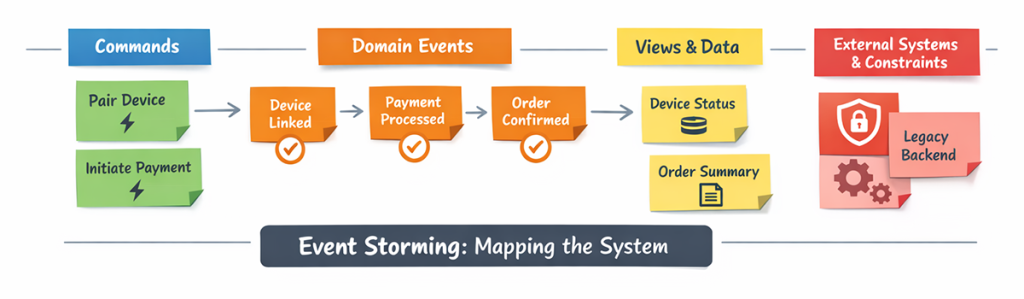
At DO OK, we favour Event Storming as the fastest and most detailed way to understand system behaviour:
- Identify domain events (“device linked”, “transaction created”)
- Connect events to the commands triggering them and the resulting views or data
- Surface constraints and external systems
This step routinely exposes constraints that would otherwise surface mid-development.
4. Defining the Future State
With the system mapped, the team outlines desired behaviours and modules. This informs early architectural direction and keeps the MVP realistic.
5. Technical Feasibility and Architecture Exploration
Developers assess scalability, integration risks and architectural patterns. Structured product discovery helps avoid architectural decisions that become costly to unwind later.
6. Prototyping and Early Validation
Lightweight prototypes or system models validate core logic before development.
7. Estimation and Roadmapping
The workshop concludes with effort estimates, risks and a high-level roadmap grounded in what the team now understands.
8. Discovery as an Ongoing Practice
Event Storming and other discovery processes are also used later in development for major new features or architectural changes, which makes discovery a repeatable tool instead of a one-off phase.
Why Discovery Prevents Costly Rework (and What Real Projects Show)
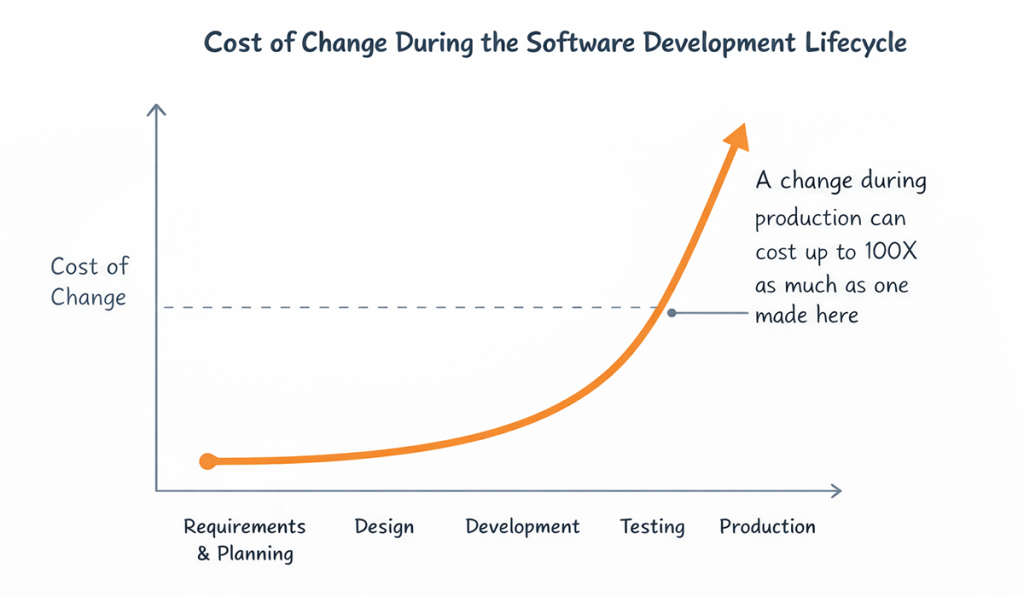
Most development delays come from issues identified too late. Studies show 40-70% of defects originate in the requirements phase, long before code is written. Errors discovered after implementation cost many times more to fix.
Discovery directly addresses these issues by clarifying requirements, mapping the system and surfacing constraints before they become expensive.
Two projects we took on at DO OK illustrate the potential impact:
BEHA: Clarifying Constraints Before Development
Event Storming revealed constraints like 2.4 GHz–only pairing, non-technical user needs and legacy backend dependencies. Identifying these early allowed DO OK to define a realistic MVP and simplify flows. Had these surfaced during development, each would have required costly redesigns and delays.
Click here to read the full BEHA case study.
HVAC IoT Platform: Fixing Bottlenecks Before Scaling
A Norwegian HVAC provider faced instability in its IoT platform. Discovery uncovered excessive microservice communication and fragile integrations. Consolidating services cut internal calls by ~70% and stabilised the system. These architectural issues would have required major refactoring if uncovered later.
Read the full case study here.
Discovery prevents rework by surfacing what stays hidden before it gets expensive to fix. But what exactly do you get from a DO OK discovery workshop, and how do you leverage those deliverables to save time and money?
Tangible Deliverables You Leave With
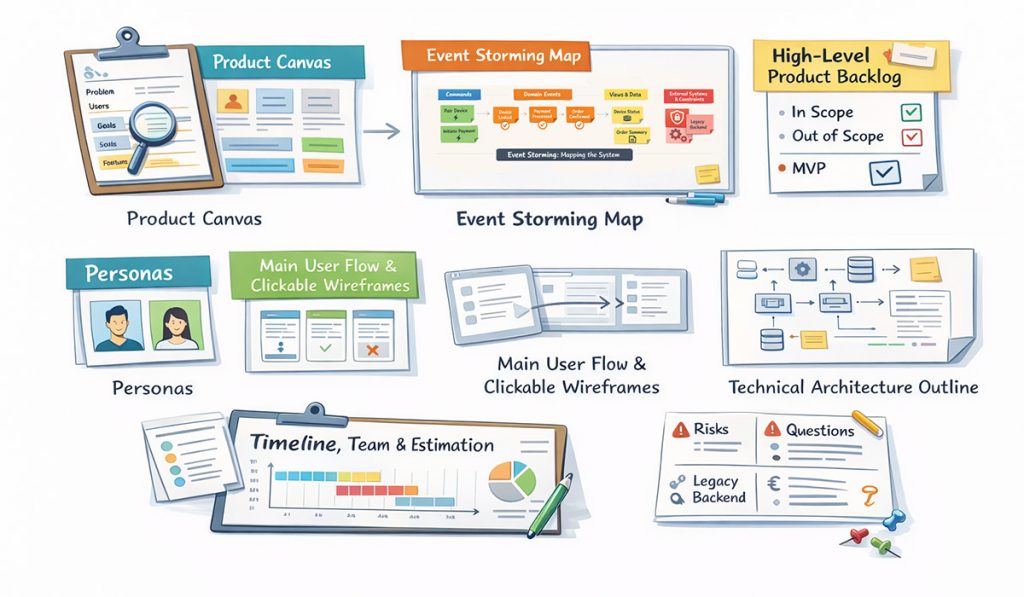
A good discovery workshop aims to define scope and clarify requirements, but the actual outputs vary. At DO OK, the deliverables are well-defined and intentionally engineered to remove uncertainty before development begins.
Here’s what you receive from a DO OK discovery workshop and why each one matters:
Product Canvas
The Product Canvas synthesises the problem, users, business goals and expected outcomes into a single shared artifact. This allows everyone from founders to engineers to work from the same strategic narrative.
Why it matters: it reduces misalignment and reconnects every future decision to the core purpose of the product. In BEHA’s case, clarifying that the real goal was a dramatically simpler experience for non-technical users directly shaped the scheduling flows and heater-pairing logic.
Personas
Personas describe the key user groups and their needs, and how they realistically interact with the system. DO OK’s personas focus on behaviours, constraints and decision-making patterns, instead of generic profiles.
Why it matters: understanding real user limitations early avoids overcomplicating features. For BEHA, aligning on a persona of a non-technical homeowner with multiple properties shaped both the onboarding flow and the minimalistic design.
Event Storming Map
This is DO OK’s most technically valuable deliverable. The Event Storming map outlines domain events, commands, system responses, external systems and constraints. It creates an end-to-end representation of how the system behaves.
Why it matters: system mapping exposes hidden complexity before it becomes expensive.
-
For BEHA, Event Storming revealed dependencies like 2.4 GHz-only Wi-Fi pairing and the need to support heater ownership across multiple properties.
-
In the HVAC IoT project, it surfaced the tangled microservice interactions that later enabled DO OK to consolidate services and reduce internal network calls by ~70%.
The result is an architectural foundation that prevents technical debt before it forms.
Main User Flow & Clickable Wireframes
These represent the first structured look at how users move through the system to achieve meaningful outcomes. Discovery helps define UI & UX flows that lead to desired user outcomes. The focus is on validating logic and confirming feasibility, not final design.
Why it matters: flows and wireframes reduce ambiguity between stakeholders and developers. For BEHA, early wireframes revealed where pairing steps needed to be simplified; for the HVAC client, they exposed data validation points required to prevent inconsistent readings from IoT sensors.
MVP Definition
DO OK defines the MVP as the smallest functional slice that delivers real user value, not a partial prototype. This deliverable identifies the boundaries of the first release: what is required, what can wait, and what is explicitly out of scope.
Why it matters: a precise MVP protects the project from scope creep and establishes clear development priorities. In BEHA’s case, excluding BLE support and HomeKit integration from the MVP saved weeks of effort and preserved budget for core functionality. Our work with Fakehunter, a verified fact-checking tool we took from project brief to 38 million users in 4 weeks, shows the timeline benefits for what a focused MVP process can deliver under pressure.
High-Level Product Backlog
This is a structured set of epics and high-value features, connected directly to the Event Storming map and wireframes. It avoids the common trap of vague wishlist-style listings.
Why it matters: the backlog becomes the foundation for estimation and sprint planning. Our HVAC project’s backlog identified which integrations and data pathways required immediate restructuring, enabling development to begin with the highest-impact technical fixes.
Technical Architecture Outline
A high-level architecture plan explains how components fit together, how data moves, which integrations are required and where future scalability concerns may arise.
Why it matters: early architectural clarity prevents the system from becoming unchangeable later. Skipping this step results in “entangled” systems that are extremely expensive to refactor. Discovery keeps the architecture adaptable.
Risk, Assumptions and Questions Log
Every uncertainty is documented openly. These include technical unknowns to dependencies, compliance considerations or external system constraints.
Why it matters: making risks visible early allows teams to mitigate them before they disrupt timelines. The HVAC project benefited heavily from this by identifying brittle third-party integrations, which helped DO OK restructure the adapter layer before it caused operational failures.
Timeline, Team Composition & High-Level Estimation
Finally, DO OK produces a realistic estimate of time, cost and required roles. These estimates are grounded in the workshop’s findings, not in guesswork.
Why it matters: thorough estimation enables transparent investment decisions. With BEHA, this process produced a feasible estimate that aligned with the client’s strategic priorities and prevented mid-build renegotiations.
Discovery Is a Short Investment That Prevents Long Delays
Discovery might be the quietest phase of a software project, but it’s the one that determines whether the rest of the work runs smoothly. Discovery workshops reduce risk for startups and scaleups of all sizes, avoiding costly rework and moving seamlessly into development by clarifying goals, aligning stakeholders, validating user needs and exposing technical constraints before production ramps up.
For CTOs and product leaders, investing in discovery is the most effective way to protect timelines and budgets while preserving long-term product health. When uncertainty is resolved early, the entire project becomes faster, cheaper, more predictable, and far more likely to succeed.
If you are planning a new product or facing uncertainty around scope, architecture or feasibility, a focused discovery workshop can bring clarity before development begins. Get in touch with us to explore how a structured Product Discovery Workshop can reduce risk, define a realistic MVP and set your team up for faster, more predictable delivery.