Compu Golf – A modern self-service and payment platform for golf clubs
Compu Partner partnered with DO OK to bring a modern, business-ready golf ball vending platform to market. The solution unifies a central management system, a mobile app for club members, payment terminals and custom hardware integrations into a fully integrated ecosystem. Delivered under tight budget constraints, the platform enables golf clubs to operate, configure and scale their vending infrastructure through a single system designed for real-world deployment from day one.
The Client
Compu Partner is a Danish technology company specialising in self-service and payment solutions, with a strong focus on the golf industry. With more than 15 years of experience, the company designs, delivers and supports systems that help organisations optimise operations, improve accessibility and increase revenue through self-service technology. Compu Partner is headquartered in Denmark and has customers in several European countries, including Germany, Switzerland, Austria, Sweden and Norway.
One of the company’s core product lines is Compu Golf, a payment and self-service solution designed for golf clubs and driving ranges. The system integrates with existing or new ball vending machines from all major brands and supports a wide range of payment methods, including credit cards, MobilePay, Vipps, Swish, vouchers, membership cards and mobile apps for iOS and Android. It also supports season cards, clip cards and differentiated pricing for members and guests.
Compu Partner’s solutions are designed to be accessible and easy to operate, including outside normal opening hours. Features such as ball level monitoring, alerts before machines run empty and simplified administration help golf clubs reduce manual work while improving the experience for guests, members and staff. All solutions are developed in the EU and comply with current technical and security standards.
To learn more about Compu Partner, click here.
Languages
TypeScript
Kotlin
JavaScript
HTML
CSS
Frameworks & Libraries
NestJS
Angular
React Native
Expo
Android SDK
Infrastructure & Storage
PostgreSQL
Mosquitto MQTT
Docker
Traefik
MinIO
Project Size
+2.500 hrs
since 2025
Client Needs
Compu Partner set out to introduce a modern golf ball vending solution that could improve user experience while remaining cost-effective for golf clubs. Their experience with existing products on the market was that many solutions had remained largely unchanged for years and were often built on proprietary systems that limited flexibility and increased operational costs.
While Compu Partner had strong expertise in hardware, including vending machines, sensors and payment terminals, they did not specialise in software delivery. To bring the product to market, they needed a partner who could design and implement the full software ecosystem around the hardware. This included backend systems, mobile applications, device communication and payment integrations.
Ease of use was a central requirement. The solution needed to be intuitive to operate, require minimal training and work reliably in everyday scenarios. At the same time, the platform had to support complex real-world use cases such as memberships, season passes, promotions, scheduled free vending and differentiated pricing based on user roles or time windows.
Budget constraints were critical. The initial rollout was planned for a limited number of machines, which meant the platform had to focus strictly on business-critical functionality. The solution needed to be production-ready from the outset, not an experimental prototype, while avoiding unnecessary complexity that would delay launch or increase costs before revenue was generated.
Compu Partner was therefore looking for a software development partner capable of delivering a fully custom solution, prioritising essential features and designing the system in a way that would allow it to scale gradually as the business expanded.
Why DO OK
Compu Partner approached us following a previous positive encounter and a clear alignment with DO OK’s experience in delivering complex IoT and cloud-based software systems. DO OK was invited to demonstrate its understanding of the product vision and the technical challenges involved, setting the stage for a deeper evaluation of the collaboration.
A two-day workshop held in Denmark played a key role in the decision-making process. During the workshop, the teams reviewed Compu Partner’s vision, analysed competing solutions and designed the overall platform together. DO OK highlighted potential technical risks, discussed alternative design approaches and explained the trade-offs required to meet the client’s budget constraints.
The workshop focused on identifying business-critical paths. Features were classified into must-have and optional elements, and the teams aligned on which deliverables would directly support launching the business and generating revenue. A high-level project plan was created, outlining dependencies, critical paths and estimated timelines, giving Compu Partner a clear understanding of how the cooperation would work from day one.
DO OK also proposed a lean technical strategy. Rather than starting with a fully scaled cloud infrastructure, the solution would begin with a simpler setup and grow alongside the business. Open-source components were recommended where they could reduce costs without compromising reliability or security.
The client responded positively to the custom-tailored approach, the attention to budget constraints and the level of technical transparency throughout the pre-delivery phase. These factors ultimately led Compu Partner to choose DO OK as their software development partner.
Project Overview
The objective of the project was to deliver a complete, business-ready platform that could be launched directly to the market. The solution consists of a central management system, a mobile app for golf club members, a payment application running on vending machines and custom IoT integrations connecting the hardware to the backend.
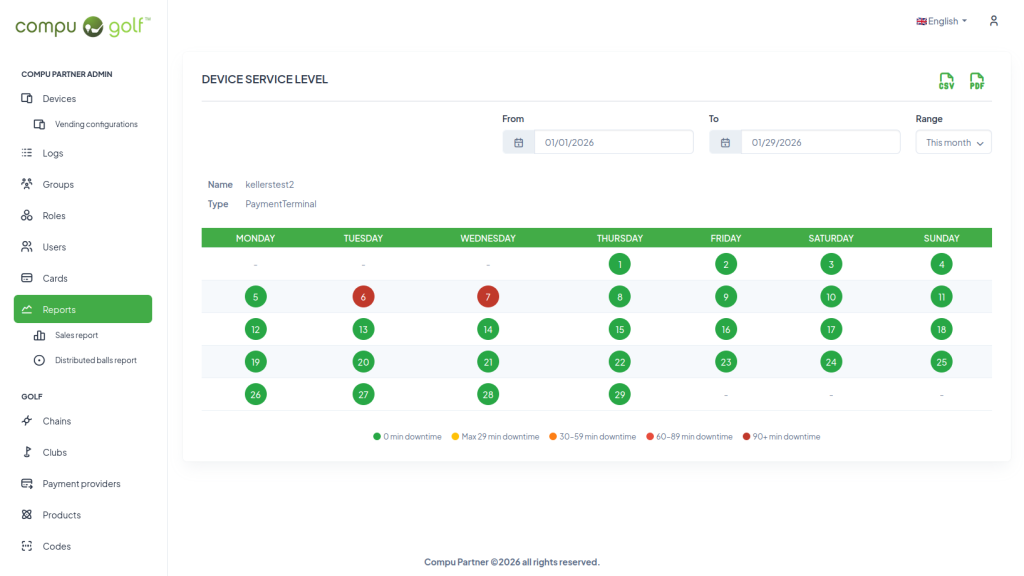
At the core of the platform is a backend API and admin dashboard built with NestJS and Angular. This central management system allows administrators and golf club managers to create and manage golf clubs, configure vending machines remotely, define products and pricing models, manage users and memberships and control machine behaviour. The system supports a wide range of configurations, including season passes, time-based access rules and products that allow free vending during specific days and hours.
The vending machines are equipped with Verifone payment terminals running a custom Android application developed by DO OK. These terminals support autonomous operation, allowing any user to purchase balls using a credit or debit card, as well as member-based usage through membership cards or the mobile app. The terminals communicate with electronic relays via GPIO, USB and serial connections to control the mechanical ball distribution system.
Near real-time communication between the machines and the backend is a key part of the solution. Actions performed in the admin panel or mobile app, such as triggering vending or updating configuration, are reflected immediately on the devices, ensuring a consistent and reliable user experience.
The mobile app, built with React Native and Expo, is designed for golf club members. Users can join clubs, manage their accounts, top up virtual wallets and purchase products. These products can be redeemed directly at vending machines and include both one-time purchases and unlimited-use options such as season passes with defined conditions.
Additional functionality includes voucher codes that golf clubs can distribute via email or SMS, ball container fill-level monitoring using custom sensors and alerting mechanisms that notify maintenance staff before machines run empty. The entire platform was delivered as a production-ready MVP, capable of supporting real users, payments and operational workflows from launch.
Challenges and Solutions
One of the primary challenges was delivering a feature-complete platform within very tight budget constraints. This required strict prioritisation and a focus on features that directly supported the business launch. DO OK addressed this by identifying business-critical paths early and deprioritising non-essential functionality.
To keep costs under control, open-source components were used where appropriate. Authentik was implemented to handle authentication flows and account linking, while Mosquitto MQTT was used to support communication between distributed devices and the backend. Custom development was focused on areas where off-the-shelf solutions could not meet the product’s requirements.
Another significant challenge was enabling near real-time interaction with vending machines distributed across multiple locations. User experience depended on immediate feedback when members interacted with machines via the mobile app. This was achieved by designing a communication layer that allowed timely updates between the backend and devices, ensuring predictable and consistent behaviour.
Authentication introduced additional complexity. The platform needed to support multiple identity providers, including Google, Facebook, Apple and Golfbox, a system widely used in the golf industry. DO OK implemented a solution that allows accounts from different providers to be connected, enabling users to log in through multiple sources while maintaining a single identity. Integration with Golfbox also made it possible to automatically assign users to membership groups based on official club data.
Hardware integration presented further challenges. Developing software for Verifone payment terminals required completing training programmes and passing formal verification processes before the application could be released to production. Similar verification steps were required for MobilePay. DO OK managed these processes while ensuring the terminal interfaces could reliably control the vending hardware.
To accelerate delivery without compromising quality, the project initially used an internal project template, which was then adapted to meet the specific requirements of the golf domain and third-party integrations.
Impact and Outcomes
The project resulted in a fully operational platform ready for deployment at golf clubs and driving ranges. Compu Partner has begun onboarding customers and rolling out the solution in the market, using the platform to support real payments, real users and day-to-day operations.
Early feedback has been positive, particularly regarding the usability of the admin dashboard. The client has highlighted the clarity of the interface and the flexibility of the system, which allows adjustments to workflows and user interactions as new requirements emerge. The ability to request and implement custom changes has been an important factor in supporting different golf club setups.
Beyond the core delivery, DO OK also supported Compu Partner with technical consultation outside the original project scope. This included preparing a demo application used at industry conferences, allowing Compu Partner to showcase the solution even when a full vending machine setup was not available.
The modular architecture provides a strong foundation for further expansion. The platform can be extended with additional reporting, monetisation features and new use cases as requested by golf clubs. The collaboration demonstrates how a complex software and IoT ecosystem can be delivered under tight constraints by focusing on business-critical functionality, careful prioritisation and close collaboration between client and development team.