
React Native’s New Architecture Narrows the Native Development Gap
React Native has long had the advantage of speed for cross platform app development, but performance concerns usually lead CTOs to favor native iOS and Android as products scale. The historical trade-off was faster delivery early on with increased risk later… But perhaps no longer.
The React Native New Architecture, now standard in React Native 0.82, changes the speed/risk equation. The New Architecture replaces legacy components that constrained execution and enables more direct interaction between JavaScript and native code, improving responsiveness and predictability in complex interfaces.
This mitigates a long-standing risk for product and engineering leaders. The gap between React Native and native development has narrowed in areas that directly affect business outcomes, like user experience stability, app maintenance, scalability and long-term development efficiency.
The time is right to reassess React Native as a foundation for modern mobile products. So what exactly changed, and why does it matter?
What Actually Changed Under the New Architecture
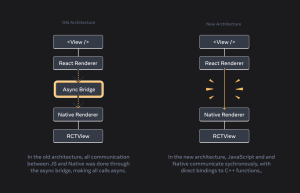
The React Native New Architecture replaces core mechanisms that previously limited performance and scalability.
Earlier versions relied on a Bridge-based model that passed data asynchronously between JavaScript and native layers. That approach was functional, but introduced latency and unpredictable behavior as applications grew more complex.
The new model removes this bottleneck through the JavaScript Interface (JSI), allowing more direct and efficient communication with native components. This reduces overhead and improves consistency across UI updates and interactions.
The React Native Fabric architecture simultaneously introduces a modern rendering pipeline aligned more closely with native platforms. All these changes work in parallel to shift React Native toward a foundation designed for performance, predictability and long-term maintainability.
Worklets and Nitro Modules Eliminate Key Performance Bottlenecks
Two specific capabilities drive much of the performance improvement: (1) worklets and (2) Nitro Modules.
- Worklets reduce reliance on a single JavaScript thread by allowing selected logic to run off the main thread. This improves animation smoothness and gesture responsiveness without blocking UI updates.
- Nitro Modules extend this by handling performance-critical operations using C++, which reduces overhead compared to traditional JavaScript modules. Tasks that directly affect user experience such as real-time interactions or data processing can execute more efficiently.
Decision-makers should consider that React Native is now far less prone to the UI lag and interaction instability that previously limited its use in complex applications. But even before exploring what the new architecture changes, take a moment to revisit the fundamentals of deciding whether React Native is right for your project.
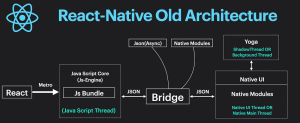
Why This Brings React Native Much Closer to Native Performance
The real impact of the New Architecture comes from how its changes compound. Removing legacy bottlenecks and modernizing rendering while enabling parallel execution collectively reform how applications behave under load.
Many historical performance issues attributed to React Native came from architectural constraints, not the framework’s core capabilities. With JSI, Fabric and worklets in place, prior constraints are significantly reduced.
For CTOs evaluating React Native vs native development, this narrows a key performance gap. Native development still offers maximum platform control, but React Native now supports smoother interactions and more predictable performance for most product use cases without defaulting to lower performance ceilings.
Strategic Implications for CTOs and Product Leaders
The React Native New Architecture fundamentally alters how CTOs and product teams should think about mobile strategy, not by removing trade-offs but by changing where they apply.
Choosing React Native previously meant faster delivery at the expense of long-term performance. That compromise is far less rigid with the changes introduced in React Native 0.82. Structural performance limitations now affect a narrower set of edge cases rather than most production scenarios.
This expands React Native’s viability for solutions like enterprise mobile apps, or fintech app development and digital health apps, where robust performance is needed, and reliability and longevity are non-negotiable. The changes allow product teams to prioritize shared codebases and faster iteration without assuming an inevitable performance ceiling.
The New Architecture also raises expectations, meaning that React Native is no longer a “shortcut” framework. It rewards organisations that treat architecture as a strategic asset and invest in the right application development team to support long-term growth.
Migration and Implementation Considerations
The React Native New Architecture reduces performance risk, but adopting it still requires deliberate planning. Migration involves reassessing dependencies, building pipelines and reformulating assumptions born under the legacy Bridge model.
Third-party libraries and custom native modules must fully support the New Architecture to avoid undermining performance gains. For this reason, a successful React Native migration should include dependency audits and phased rollouts, and leverage clear performance benchmarks for validation of gains.
At DO OK, we applied this approach with Actify, a mature digital health app built with React Native and supported over multiple years. Our decision to migrate Actify to the New Architecture was driven by a clear architectural case linking React Native performance improvements to long-term product stability and scalability. We used these value propositions to align stakeholders and secure client buy-in before the migration began.
The New Architecture lowers technical ceilings, but real value comes from disciplined execution and informed decision-making, with the ability to translate architectural improvements into business outcomes.
How DO OK Delivers High-Performance React Native Apps
Delivering performance gains with the React Native New Architecture depends on architectural discipline and the ability to translate technical change into measurable product value.
DO OK approaches React Native as a long-term platform solution. This means designing applications with scalability in mind from the outset, selecting dependencies carefully and treating performance as a product requirement rather than a post-launch concern. That same mindset applies to modernization and migration decisions as frameworks evolve.
We decided on moving Actify to the New Architecture via structured assessment of performance, maintainability, scalability and future product needs. DO OK was able to articulate how these architectural improvements aligned with business goals to secure stakeholder confidence before implementation began.
This combination of technical expertise and strategic communication is central to how DO OK operates as a software outsourcing company. We work to align architecture choices with product objectives, helping organisations adopt React Native in a way that supports reliable delivery along with sustainable growth and long-term app maintenance and scalability.
A New Era for Cross-Platform Mobile Development
The React Native New Architecture is much more than a marginal upgrade. It creates a structural shift in how the framework performs and scales. React Native 0.82 addresses long-standing architectural constraints to narrow the gap between cross platform app development and native development in ways that materially affect product outcomes.
For CTOs and product leaders, this changes the development risk profile. React Native can now support more demanding use cases with greater confidence, provided it is implemented with the right architectural discipline and expertise. Performance is no longer the default limiting factor it once was.
The New Architecture creates an opportunity for teams to reassess mobile strategies, balancing speed, scalability and long-term maintainability more effectively. When paired with an experienced application development team, React Native becomes a credible foundation for modern mobile products, not the short-term compromise it used to represent.
Align Your Mobile Architecture with Long-Term Product Goals
If you are evaluating the React Native New Architecture for a new product or considering a migration from an existing codebase, DO OK can help assess whether it aligns with your performance, scalability, delivery, and long-term product goals. Our teams work with CTOs and product leaders to translate architectural decisions into long-term product value.
Contact us and let’s talk about how we can help future-proof your cross platform products today.